What Counts as Abandonment Under MLC 2006
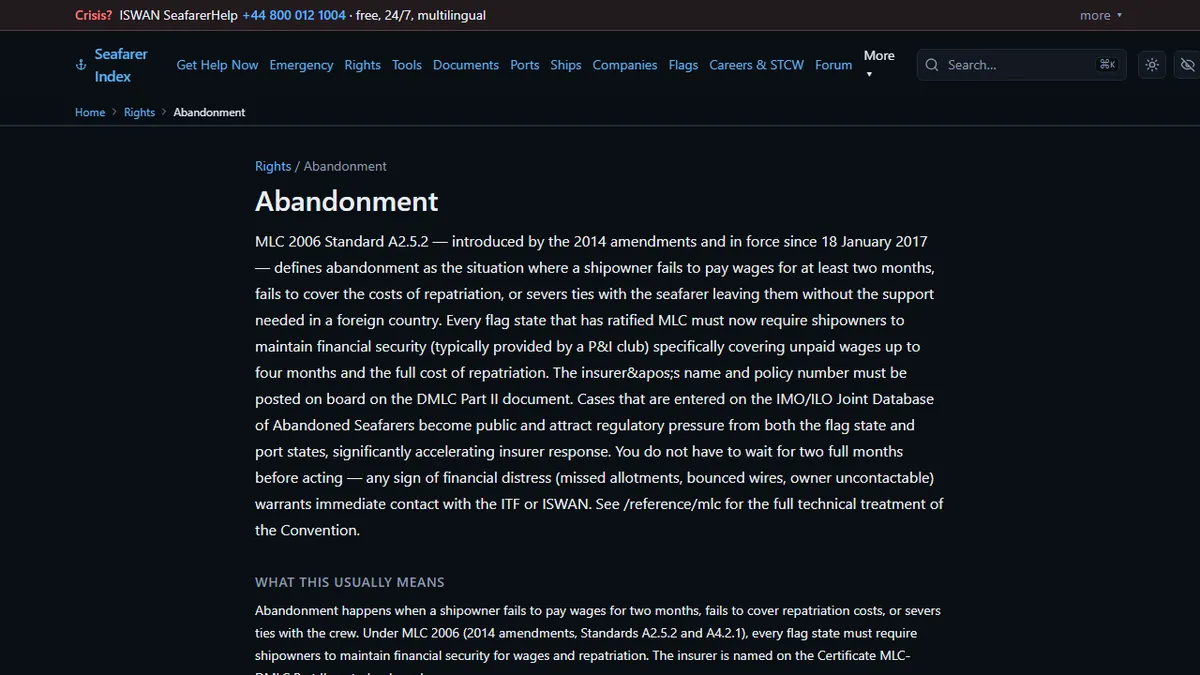
Abandonment is defined in the Maritime Labour Convention 2006 as a situation where a shipowner fails to fulfil certain fundamental obligations to the crew. Those obligations include covering the costs of repatriation when the contract ends, paying wages that have fallen due, and providing basic necessities (food, water, and shelter) while the crew remains aboard.
Critically, abandonment does not require the owner to have physically disappeared. A crew stranded in a foreign port without wages, without food provisions being replenished, and without a confirmed repatriation arrangement is abandoned in the legal sense even if the company nominally still exists. The convention was deliberately written to capture this reality, because many abandonment cases involve shipowners who are technically present but unresponsive rather than ones who have simply vanished.
Why Abandonment Happens: The Failures That Cause It
Abandonment cases cluster around predictable patterns. The most common is owner insolvency combined with flag-state negligence. A shipowner operating on thin margins charters vessels through layers of intermediaries, uses a flag state with no effective enforcement capacity, and, when the economics collapse, stops funding the vessel's operations. Crew who were due wages last month receive nothing this month, provisions run low, and the agent at port stops answering calls.
A second common pattern involves vessels that have been detained by port state control and whose owners calculate that the cost of clearing the deficiencies exceeds the vessel's value. In these cases, abandonment is sometimes a deliberate commercial decision rather than a failure driven by insolvency. The crew caught in that calculation had no say in the decision and bears its consequences.
The Ports and Flags Where Abandonment Cases Cluster
The IMO/ILO joint database of abandonment cases, which has tracked reported incidents since 2004, shows a consistent geographical pattern. Ports in the Middle East, South and Southeast Asia, and parts of Africa feature disproportionately in abandonment records, partly because these are high-traffic anchorage points, partly because the regulatory environments ashore are less likely to compel a fast resolution, and partly because the vessels using these routes tend to be older and more financially marginal.
Flags with no MLC ratification, no ITF presence, and no bilateral welfare agreements with the crew's home countries appear repeatedly in the ownership chain behind abandoned vessels. The connection is not coincidental.
Step-by-Step: What to Do in the First 48 Hours
When you first suspect the ship may be heading toward abandonment (wages are weeks overdue, the master has stopped receiving answers from the office, or provisions have not been replenished on the expected date), the most important thing you can do is document everything. Record dates, amounts owed, communications attempts, and any responses. Photographs, logged entries, and screenshots of messages all constitute evidence.
The step-by-step emergency guide for abandoned seafarers walks through the escalation sequence in detail. In the first 48 hours, the priority contacts are the nearest ITF inspector, the port authority of whatever port the vessel is in or approaching, and the welfare organisation operating in that port. Sailors' Society, Mission to Seafarers, or Stella Maris are present in most major ports globally.
Contact your flag state administration directly. Under MLC 2006, the flag state has obligations toward abandoned crew and is required to facilitate repatriation if the shipowner cannot or will not. Many seafarers skip this step because they have low confidence in the flag state's responsiveness. That is understandable, but the formal contact creates a record and triggers obligations.
Who Is Legally Responsible and How the MLC Financial Security System Works
The primary obligation rests with the shipowner. MLC 2006 requires shipowners to hold financial security (typically provided by a P and I Club or a specialist insurer) specifically to cover repatriation costs and outstanding wages in the event of abandonment. The 2014 amendments to MLC strengthened these requirements and introduced minimum coverage periods.
The MLC 2006 abandonment rights and financial security rules explain how this mechanism works in practice, including how to identify the insurer and how to make a direct claim. This financial security instrument is the backstop that MLC 2006 was designed to create. It means that even if the shipowner is insolvent, there is a funded mechanism that can pay repatriation costs and at least four months of outstanding wages.
The practical trigger for a claim is typically the ITF or a welfare organisation acting as intermediary. Individual seafarers can make claims directly, but the bureaucratic demands involved make professional advocacy highly effective.
The IMO/ILO Database and How It Forces Repatriation
Cases registered in the joint IMO/ILO abandonment database enter a publicly visible record that creates diplomatic pressure on flag states and port states to act. Flag state administrations listed repeatedly in that database face scrutiny from other IMO member states and risk MoU inspection consequences. The public nature of the record is a genuine lever.
Registering your case (or having an advocacy organisation register it on your behalf) is therefore more than an administrative step. It escalates the matter to an intergovernmental forum where inaction by the responsible flag state becomes politically costly.
How Families Can Help From Shore
Families ashore are often better positioned than the crew to make noise in the right places. A family member in the Philippines can contact the Philippine Overseas Employment Administration, which has a specific helpline and case management function for abandoned Filipino seafarers. Indian seafarers' families can contact the Directorate General of Shipping. The ITF affiliates in major seafarer-supply countries maintain direct contacts with the global ITF inspection network and can escalate cases more quickly than a crew member communicating from a vessel with limited connectivity.
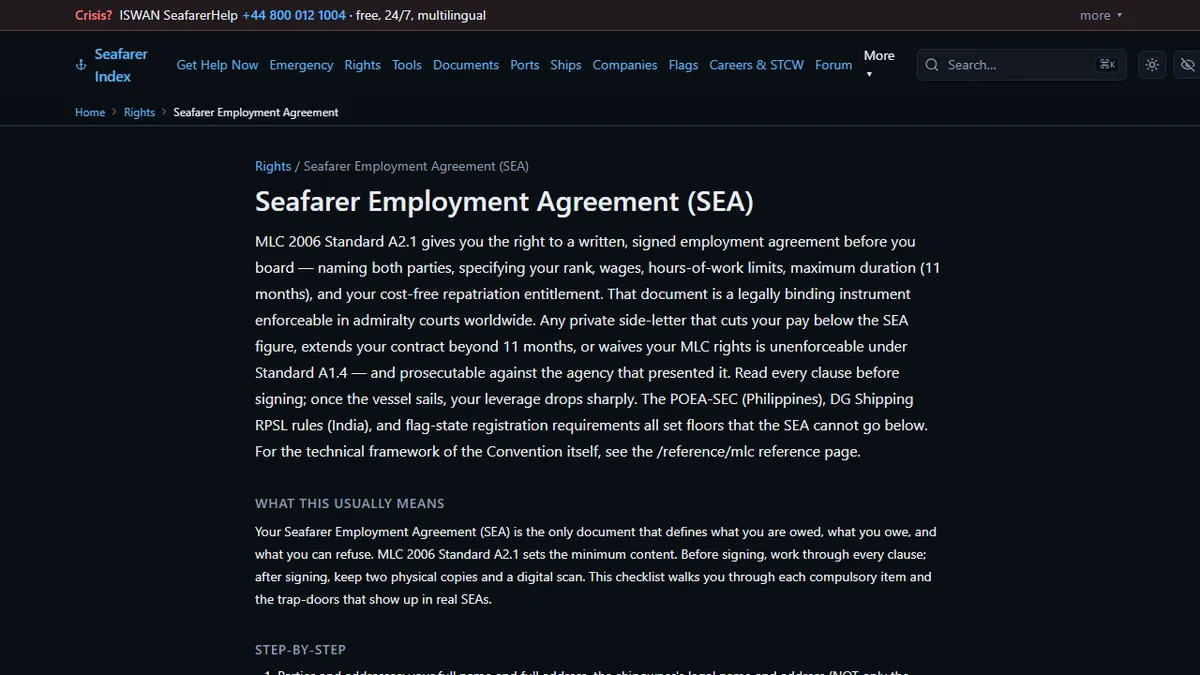
Share as much documentary evidence as possible with family members before communications deteriorate further. The name of the vessel, the flag, the owner's registered address, the manning agency name, the port where the vessel is located, and copies of wage slips or the SEA all give advocates something concrete to work with. An abandonment case with good documentation resolves faster than one where the basic facts are unclear.