The first thing to settle is not which gym
Kickboxing has no single rulebook. Sixteen distinct codes are in active use, and they disagree about leg kicks, knees, the clinch, throws, head punches and even footwear. A statement like "knees are legal in kickboxing" is only true under some codes. For a striker who wants to compete, the ruleset is not a minor detail; it is the sport itself. Training for the wrong one means spending months developing weapons that will be illegal or undervalued on fight night.
The choice is not about which ruleset is best. It is about where you want to fight, what you want to be able to do, and what your body rewards. This guide walks through the main families of rules and the questions that separate them.
The K-1 family rewards volume and damage in open range
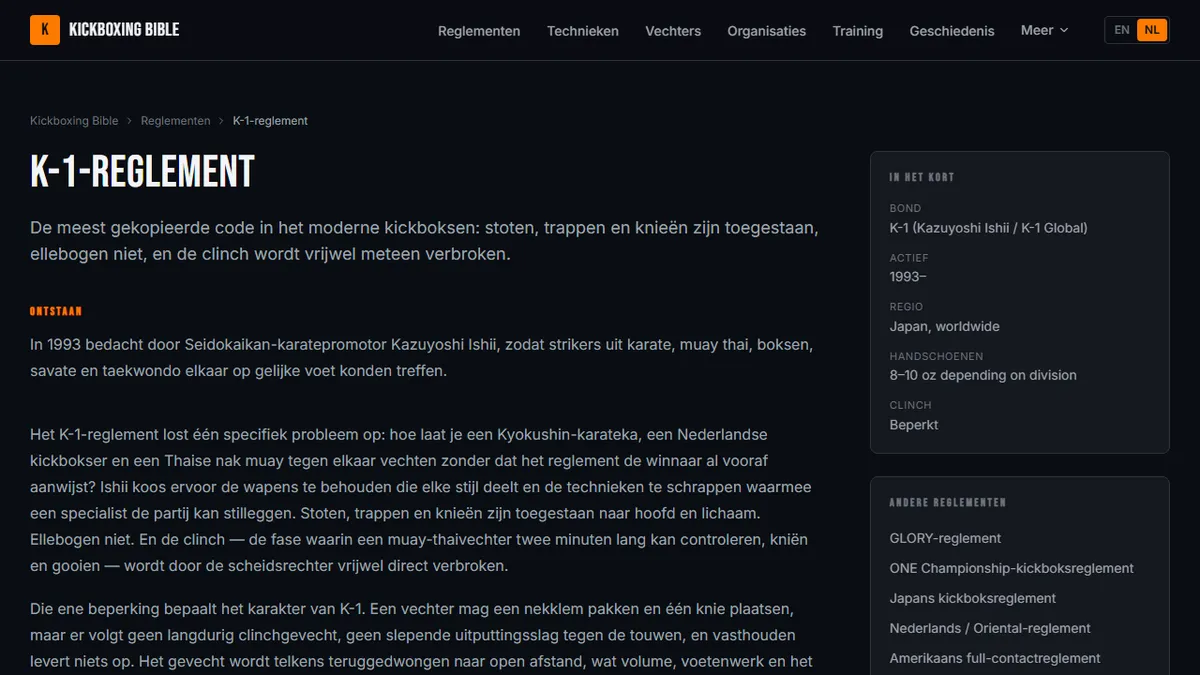
K-1 was devised in 1993 by Seidokaikan karate promoter Kazuyoshi Ishii to let strikers from karate, Muay Thai, boxing, savate and taekwondo meet on common ground. Punches, kicks and knees are legal to the head and body. Elbows are not. The clinch is broken up almost immediately, which means a fighter can catch a collar tie and land a single knee, but there is no extended clinch battle and no grinding attrition against the ropes. The fight is forced back to open range again and again.
That single restriction gives the code its texture. It favours volume, footwork and the ability to hurt someone in a two-second exchange. Scoring rewards damage above all, knockdowns count heaviest, and a draw after regulation triggers an extension round rather than a split decision. This is the most widely copied code in modern kickboxing: GLORY tightened the clinch break further and began penalising passivity, while ONE Championship kept the weapons but shifted judging toward near-terminal impact. If you want to fight under a global promotion, you will almost certainly be fighting under a descendant of these rules. You can read the specifics in the k-1 rules in detail before you build your game around them.
The Dutch / Oriental code is K-1's working-class ancestor
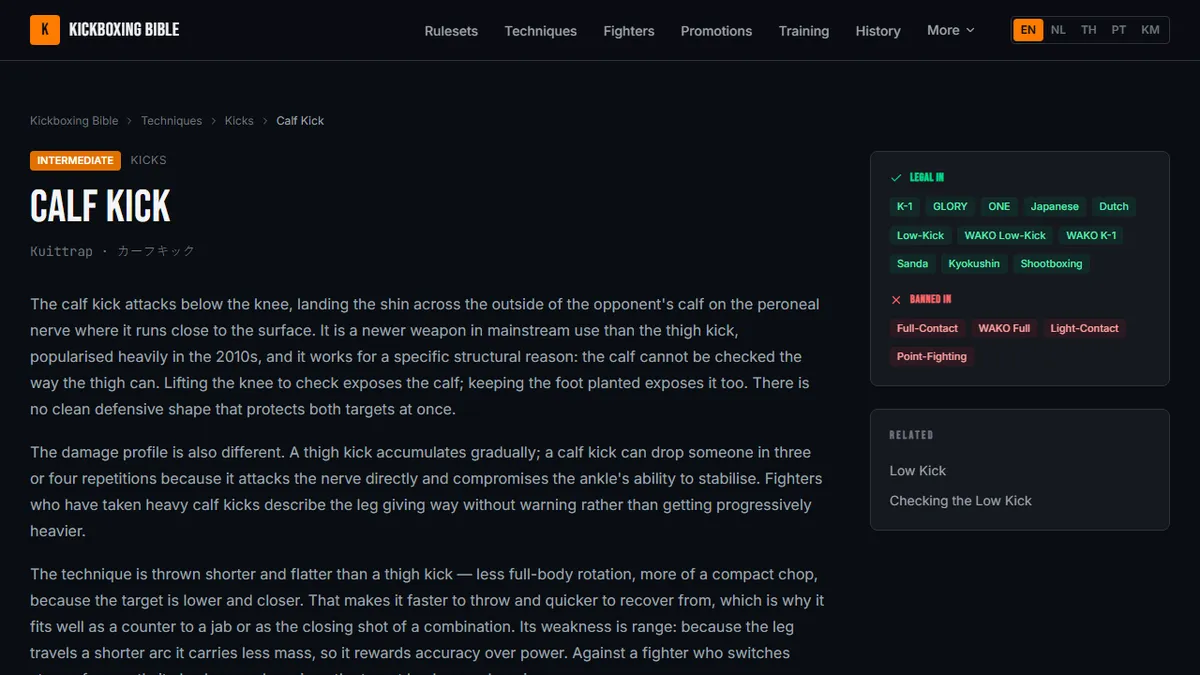
"Oriental rules" is the name Dutch promoters gave to their working compromise in the mid-1970s, and it is arguably the most influential ruleset in the sport after K-1 itself. Low kicks are central. Knees are legal. The clinch is allowed for a moment, long enough to land, not long enough to grind. Elbows are out.
That combination shaped Dutch kickboxing. Because the clinch cannot be used to rest or stall, and because leg kicks score, the optimal strategy became sustained boxing combinations that finish on a low kick. A Dutch fighter's default is not a single heavy weapon but a chain: hands to move the guard, then the leg kick underneath it. If you like pressing forward and chopping the lead leg, this is the ruleset that rewards that style most directly. It also explains a long-running stylistic argument: under Thai stadium scoring, that same volume-punching approach is undervalued; under Dutch rules and their K-1 and GLORY descendants, it is the winning formula.
American full-contact and low-kick are the no-knee options
American full-contact kickboxing was built by karate people, and it shows. Formalised from 1974 under the PKA banner, it restricts strikes to above the waist. No leg kicks at all. Fighters wear foot pads as well as boxing gloves. The clinch does not exist as a phase; referees separate on contact. Knees and elbows are illegal.
The rule that most defines the code is the kick minimum. Because early full-contact bouts had a habit of collapsing into ordinary boxing, sanctioning bodies imposed a required number of kicks per round, commonly eight, with penalties for falling short. It is the only major ruleset that legislates for how a fighter must fight rather than only what they may not do.
That above-the-waist restriction is also why American full-contact fighters struggled badly in the first international meetings. A fighter with no defence against the leg kick, meeting a Thai or Dutch opponent under a rulebook that permitted it, was in serious trouble within a round. Those encounters, most famously Rick Roufus against Changpuek Kiatsongrit in 1988, pushed the American scene toward adopting low kicks.
American low-kick rules are the result: full-contact plus leg kicks, but still no knees and no clinch. Once the lead leg is a target, a fighter can no longer stand square and hunt for head shots; stance, weight distribution and the ability to check become fundamental. The code sits halfway between American full-contact and the Dutch code. If you come from boxing or karate and want to avoid knees and clinch work entirely, this is your middle ground.
WAKO low-kick is the amateur competitive standard
For most amateur strikers, the ruleset that will actually govern your bouts is not the one you see on television. WAKO, the world association of kickboxing organisations, runs several codes, and low-kick is one of the most common at national and international amateur level. If your goal is to compete as an amateur, the wako low-kick rulebook is the one you will most likely be matched under.
This matters because amateur rulesets shape how coaches teach beginners. A gym that prepares fighters for WAKO low-kick will spend its drilling time on leg-kick defence, open-range footwork and combinations that finish low. A gym that prepares fighters for American full-contact will spend its drilling time on hand speed and high kicks. Before you commit to a camp, ask which rulebook the coaches actually train for.
Match the ruleset to your weapons and temperament
The practical question is not which ruleset is more authentic or more exciting. It is which one lets you use the tools you already have and punishes the tools you do not.
If you are tall and like to fight at range, the K-1 family rewards you. The short clinch and fast break keep the fight in open space, and the damage-first scoring means a clean shot on the inside is worth more than a hundred jabs from the outside. If you are a pressure fighter with heavy hands, the Dutch code was built for you: the chain of punches into a low kick is the exact pattern that Oriental rules made successful. If you are a karateka with a background in point fighting, American full-contact gives you a home, but you will need to learn leg-kick defence before you meet anyone from outside that scene.
If your instinct is to clinch and knee, you should be honest with yourself: kickboxing rulesets, almost all of them, will cut that phase short. The extended clinch is the territory of Muay Thai, and no amount of fighting under K-1 or Dutch rules will let you develop it. Likewise, if elbows are central to your game, kickboxing is not your sport. The no-elbow rule is one of the few things every major kickboxing code agrees on.
Check what your gym and local scene actually run
A ruleset only exists when there are promotions and referees to enforce it. The most beautiful K-1 game plan in the world is useless if every amateur event within driving distance runs American low-kick. Before you make a decision, find out what your local federation sanctions, what the regional shows use, and what the gym down the road prepares its fighters for.
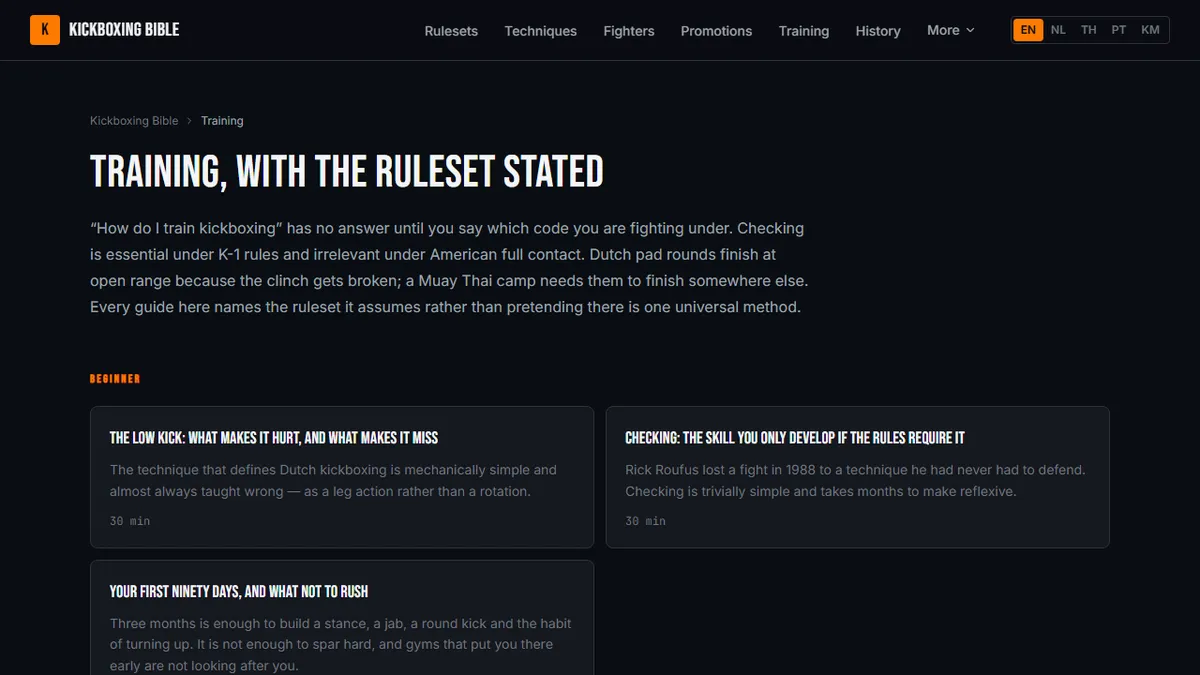
This is also where the choice becomes concrete. The fastest way to understand a ruleset is to train under someone who has to work within it every day. Look through kickboxing training guides that assume a specific code; if the drills are built around checking leg kicks and resetting after a short clinch, that will tell you what the rules reward. If the drills are built around high-volume punching and no clinch at all, you are in an American-style gym.
The right ruleset is the one that makes you train the things you are currently avoiding. If you hate checking kicks, fight under a code that makes leg kicks legal. If you hate the clinch, fight under a code where it barely exists. If you want to be a complete striker, pick the ruleset that exposes your weaknesses, not the one that hides them.